Digital Payment Tracker for Small Business Nigeria: The Smart Way to Control Your Cash Flow
The Reality of Running a Small Business in Nigeria
Running a business in the heart of Lagos, the markets of Kano, or the tech hubs of Abuja is an exercise in mental endurance. As a growth strategist, I see it daily: entrepreneurs are drowning in the chaos of "untracked receivables." Money flows in from various customers across different platforms, while operational expenses drain the accounts daily. In this fast-paced environment, financial visibility is the first casualty.
The pain points are systemic. You face delayed payments that choke your working capital and clients who simply "forget" to settle their invoices because you haven't prompted them. Without a rigorous system to capture these transactions, "leakages" become inevitable. Proper tracking isn't just a administrative task—it is a mandatory survival strategy for any serious owner looking to optimize their cash flow.
Defining the Digital Payment Tracker
A digital payment tracker is a purpose-built tool designed to eliminate the "mental load" of business finance. It replaces the traditional reliance on tattered notebooks, scattered bank alerts, and dangerous guesswork with a streamlined, central repository for every kobo that enters or leaves your business.
Its primary functions include:
- Recording Payments: Instantly logging every transaction to ensure no income is overlooked.
- Tracking Debtors: Identifying exactly which customers owe money and for how long.
- Monitoring Daily Cash Flow: Providing a real-time pulse on income versus expenditure.
- Financial Reconciliation: Offering a clear, high-level overview of your business's health at any given moment.
While the concept is simple, the reason most Nigerian businesses fail to adopt it isn't a lack of will, but the unique hurdles of our local marketplace.
The Struggle: Why Nigerian Businesses Face Payment Challenges
Nigerian entrepreneurs operate in a high-friction environment where fragmented data is the norm. A digital system is powerful because it directly addresses these localized hurdles:
- Delayed Payments: In our "credit-heavy" business culture, selling a service often happens today while the ₦ (Naira) arrives weeks later, creating a gap in working capital.
- Lack of Central Records: Financial data is currently a mess of WhatsApp chat history, random bank SMS alerts, and handwritten notes that are easily lost or destroyed.
- Poor Follow-Up: Business owners are too busy "hustling" to manually track down every debtor, leading to thousands of ₦ in uncollected revenue.
- Cash Flow Confusion: Without a dashboard, you cannot accurately state your daily profit or your total exposure to debt.
Core Features of an Effective Tracking System
To move from survival to growth, your tracking system must possess these five key features:
- Easy Payment Recording: The ability to log a sale in seconds, ensuring the record is captured before the next customer arrives.
- Customer Payment Tracking: A granular view of who has paid, who is outstanding, and the age of those debts.
- Real-Time Dashboard: A centralized "command center" where your entire financial position is visible at a glance.
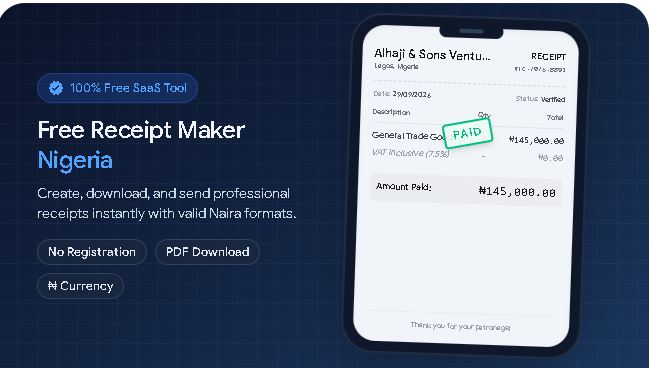
- Instant Receipt Generation: The power to create and issue professional digital receipts immediately upon payment.
- Automated Payment Reminders: A system that does the "dirty work" of chasing debtors via automated follow-ups, removing the emotional stress of manual debt collection.
The Business Impact: Benefits of Going Digital
Transitioning to a digital tracker is a strategic move that pays dividends in business scalability:
- Get Paid Faster: Automated reminders act as a professional nudge, significantly reducing the "payment turnaround time" from customers.
- Stay Organized: Centralizing records prevents the loss of data that occurs when a phone is lost or a notebook is misplaced.
- Professionalism and Repeat Business: Issuing a digital receipt via WhatsApp builds institutional trust. A customer who perceives your business as organized is far more likely to return for a second purchase.
- Time Efficiency: You regain hours previously wasted scrolling through WhatsApp chats to verify if a specific customer actually paid.
- Error Reduction: Automation eliminates the calculation mistakes inherent in manual bookkeeping, ensuring your "reconciliation" is always accurate.
Target Users: Is This For You?
If you answer "Yes" to any of the following, a payment tracker is no longer optional for your business:
- [ ] Small business owners managing daily inventory
- [ ] Freelancers juggling multiple client invoices
- [ ] POS operators handling high-frequency transactions
- [ ] Online sellers operating via Instagram or WhatsApp
- [ ] Service providers (Rentals, Consulting, Artisans)
The Bottom Line: If you collect money from customers in Nigeria, you need a digital system to track it.
Expert Advice: Mistakes to Avoid & Getting Started
Common Pitfalls
Avoid these "leakage" points that cost Nigerian businesses millions annually:
- Relying on memory: Your brain is for creating ideas, not storing ₦ balances.
- Mixing records: Spreading data across different, disconnected apps.
- Skipping receipts: Failing to provide a paper trail erodes customer trust and complicates audit trails.
- Ignoring the "Aged" Invoices: Letting unpaid bills sit until the customer disappears.
Implementation Steps
- Choose a Tool: Select a local-first digital tool designed for the Nigerian workflow.
- Add Your Customers: Populate your digital ledger with your current client base.
- Record Immediately: Make it a rule to log the transaction the moment the deal is struck.
- Send Receipts: Always issue a digital receipt to finalize the professional interaction.
- Review Daily: Spend five minutes every evening checking your dashboard to understand your position.
Consistency is the only bridge between "having a tool" and "having a profitable business."
The Importance of Local Solutions
Many global accounting tools fail Nigerian entrepreneurs because they are built for Western markets. They often require complex double-entry accounting knowledge, assume you are tracking in Dollars ($), or demand expensive monthly subscriptions in foreign currency.
A local solution like NairaTrack is superior because it offers:
- Full Naira (₦) Support: No messy conversions or currency mismatches.
- WhatsApp Integration: Built to work within the primary communication channel of Nigerian commerce.
- Simplicity: Designed for the "everyday" business owner, not a chartered accountant.
- Workflow Alignment: It understands the specific way we trade, collect, and follow up in this market.
Q&A (Frequently Asked Questions)
What is the best digital payment tracker for small business in Nigeria?
The best digital payment tracker for small businesses in Nigeria is NairaTrack, as it offers full Naira (₦) support and seamless WhatsApp integration tailored for the local workflow.
How can I track customer payments easily in Nigeria?
The easiest way is to use a mobile-friendly tracker that allows you to record sales instantly and monitor outstanding ₦ balances via a real-time dashboard.
Is there a free payment tracking app for Nigerian businesses?
Yes, tools like NairaTrack offer free or basic plans that allow small businesses to digitize their records without upfront costs, providing a pathway to scale as they grow.
How do I know who owes me money in my business?
A digital tracker provides an "Outstanding Balances" report that automatically flags every customer with a pending payment, removing all guesswork from your collections.
Can I send receipts to customers via WhatsApp?
Yes. Modern trackers allow you to generate professional digital receipts that can be shared instantly via WhatsApp, which enhances your business's credibility.
How do I reduce late payments from customers in Nigeria?
You can drastically reduce delays by implementing automated payment reminders and issuing professional invoices the moment a service is delivered.
What is the easiest way to manage business cash flow?
The most effective method is a centralized dashboard that visualizes your total income, pending ₦ payments, and daily expenses in a single view.
Do I need accounting knowledge to use a payment tracker?
No. These tools are specifically designed for entrepreneurs and traders; you do not need formal accounting training to manage your records effectively.
Can a payment tracker help my business grow?
Absolutely. By eliminating untracked receivables and optimizing your working capital, you gain the financial clarity needed to make better investment decisions.
The Smart Way Forward
To scale in this economy, you must stop operating in the dark. NairaTrack solves the "WhatsApp Chat confusion" by transforming those fragmented conversations into organized, actionable financial records. It allows you to track all customer payments in one place, send instant receipts, and monitor your cash flow with the precision of a corporate entity.
Stop guessing your numbers. Start managing your money properly. Visit www.nairatrack.com today and start using the digital payment tracker built specifically for the Nigerian small business owner.